
Research on Indentation Fracture of 4H-SiC Single Crystal –
PAM-XIAMEN can provide N, P, semi insulating SiC substrates and customized processing services, please consult: [email protected].
1. Abstract
Studying the deformation and fracture behavior of single crystal silicon carbide (SiC) under indentation has important scientific and practical significance for its microfabrication. This study investigated the indentation fracture behavior of 4H-SiC single crystals perpendicular to the (0001) plane using Berkovich, Vickers, and Knoop indenters. Radial cracks were observed under all test loads, and Vickers and Knoop indentation also induced transverse cracks. The fracture toughness measured by Vickers indentation is lower than that of Knoop and Berkovich indentation. Berkovich indentation shows a decrease in fracture toughness with increasing load at low loads, indicating the presence of surface hardening phenomenon. The surface energy estimated based on radial cracks is in good agreement with the literature values. This article establishes an analytical model for the total energy dissipation in a single indentation cycle, quantifying the contributions of cracking and plastic deformation to energy dissipation. Analysis shows that in Berkovich indentation, when the load is greater than 75mN, the energy dissipation caused by cracking is far greater than that of superplasticity deformation (more than 8 times), indicating that crack propagation is the main energy dissipation mechanism.
2. Indentation Experiment
The experiment used a 4H-SiC single crystal wafer with a diameter of 3 inches and a thickness of 350µm, and its crystal structure was characterized by Raman spectroscopy. Use a nanoindentation instrument equipped with a Berkovich indenter to conduct indentation experiments along the [0001] crystal direction within the range of 10~500mN; Vickers and Knoop indenters are used for microhardness testing, with Vickers testing covering six different loads ranging from 25 gf to 500 gf, with each group repeated more than 30 times to ensure statistical reliability. Using an optical microscope to measure indentation size and crack morphology, calculating contact stiffness and apparent elastic modulus based on the Oliver Pharr method, and evaluating fracture toughness based on indentation cracks using empirical formulas. In addition, an analytical expression for the total energy dissipation of a single indentation was established to distinguish the energy contribution of cracking and plastic deformation mechanisms.
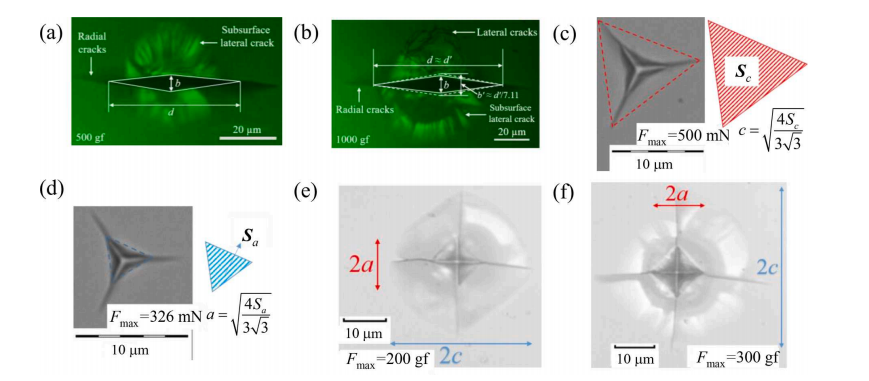
Fig. 1 Nanoindentation experiment imprint: Knoop indentation at (a) 500gf and (b) 1000gf; Berkovich indentation at (c) 500mN and (d) 326mN; Vickers indentation at (e) 200gf and (f) 300gf
3. Conclusion
This study systematically analyzed the indentation fracture behavior of 4H SiC single crystals in the [0001] direction. All indentation tests induce radial cracks, while Vickers and Knoop indentation also cause transverse cracks that propagate to the surface under high loads. Vickers hardness display is independent of load. The fracture toughness calculated based on Vickers indentation is 1.9 MPa · m ¹/², the Knoop indentation result is 2.4-2.7 MPa · m ¹/², and the Berkovich indentation result is 2.6-2.7 MPa · m ¹/² under a load of 0.3 N or more, which is comparable to the Knoop value but higher than Vickers, reflecting the influence of material anisotropy. Under low load, Berkovich indentation shows a decrease in fracture toughness with increasing load, confirming the existence of surface hardening. The established indentation energy dissipation model shows that in Berkovich indentation, the energy consumed by cracking is significantly higher than that of plastic deformation, especially at loads above 75mN, where the energy consumed by cracking exceeds eight times that of plastic deformation, indicating that crack propagation is the dominant energy dissipation mechanism.

Whether you need SiC wafer for research or for industrial applications, please contact us email at [email protected] and [email protected].
Reference:
Hou, D., Liu, M., Liu, S., & Yang, F. (2024). Indentation fracture of 4H-SiC single crystal. International Journal of Mechanical Sciences, 270, 109096.