
Defects Induced by Carbon Injection in 4H-SiC +
PAM-XIAMEN is able to grow 4H-SiC homoepitaxial wafers. For more epitaxial details, please consult: [email protected].
4H-SiC exhibits excellent performance in high temperature and high voltage environments, especially suitable for power devices. However, internal point defects such as carbon vacancies (VC) can significantly reduce the lifetime of minority carriers and limit the performance of bipolar devices. To eliminate VC, researchers have developed various carbon implantation methods, including annealing after ion implantation, thermal oxidation, and high-temperature annealing using carbon caps (C-caps). The commonality of these methods is that they undergo annihilation reactions with VC by injecting carbon interstitial atoms (Ci). However, when the injected carbon exceeds the VC concentration, new carbon gap related defects will form, which may also affect the electrical and optical properties of the material.
1. Defect Energy Levels Induced by Carbon Injection
1.1 Majority Carrier Trap
Through deep level transient spectroscopy (DLTS) analysis, researchers observed multiple new electron traps in the n-type 4H-SiC epitaxial layer after carbon injection. Karsthof et al. reported three main energy levels: E0.38, E0.59, and E0.7, with activation energies of 0.38 eV, 0.59 eV, and 0.7 eV, respectively. The concentrations of these energy levels vary with increasing injection time, with E0.38 disappearing after high-temperature bias annealing, indicating that it may originate from unstable Ci.
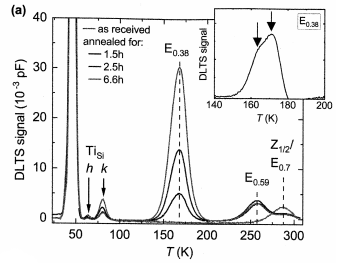
Fig. 1 DLTS spectrum: variation of E0.38, E0.59 and E0.7 energy levels with annealing time
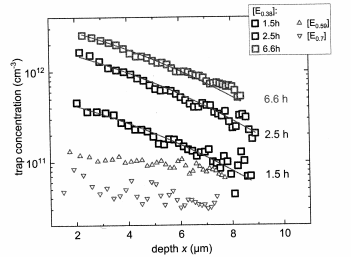
Fig. 2 Concentration depth distribution of carbon induced defects
Bathen et al. further expanded the temperature range and found that in addition to the aforementioned energy levels, a series of energy levels such as ON0a (EC-0.58 eV), ON0b (EC-0.69 eV), ON1 (EC-0.89 eV), and ON2 (EC-1.15 eV) appeared. These energy levels have also been observed in thermal oxidation experiments, but in this study, due to the minimal involvement of oxygen, it was confirmed that they originate from carbon related defects.
1.2 Minority Carrier Trap
Bathen et al. revealed the effect of carbon injection on defects in the valence band region through minority carrier transient spectroscopy (MCTS) analysis. In the original sample, there are shallow boron energy levels (B) and deep boron energy levels (D-center). After carbon injection, the concentrations of B and D-center significantly decreased, especially almost disappeared after 1.5 hours of annealing. In addition, after 6.6 hours of annealing, new minority carrier traps T1 (EV+0.46 eV), T2 (EV+0.56 eV), and T3 appeared, which may be related to carbon clusters or carbon boron composite.
2. Microstructure and Stability of Defects
The E0.38 energy level is speculated to be related to the single carbon gap, but its thermal instability is different from the reported M center (attributed to Ci) in the literature. Karsthof et al. pointed out that E0.38 disappears and cannot be recovered after zero bias annealing at 450 K, while the M center exhibits reversible bias induced transformation behavior. Therefore, E0.38 may represent another configuration or charge state of Ci.
For more stable ON series energy levels, Bathen et al. speculated that they may originate from carbon clusters, such as carbon double gap ((Ci) 2) or carbon anti ring structure (C3) Si). These complexes have high formation energy and thermal stability, consistent with the observed ON energy level at high temperatures in experiments.
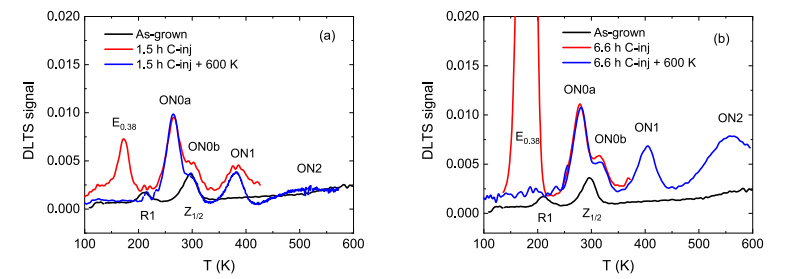
Fig. 3 DLTS spectrum shows the effect of C injection after annealing with C cap after (a) 1.5 hours; (b)6.6h
3. Effect of Carbon Injection on the Lifetime of Minority Charge Carriers
Bathen et al. investigated the effect of carbon injection on the depth distribution of minority carrier lifetime using time-resolved photoluminescence (TRPL) technology. Research has found that as the annealing time increases, the lifespan distribution shows a trend of first decreasing and then increasing: after annealing for 1.5 and 2.5 hours, the overall lifespan decreases, while after annealing for 6.6 hours, the lifespan within the 50μm range of the surface layer increases by 10-20%.
The initial decrease in lifespan may be related to changes in surface recombination velocity caused by high-temperature treatment, while subsequent improvements are attributed to the annihilation or recombination of lifetime killer defects such as Ci, VC, and D-center.
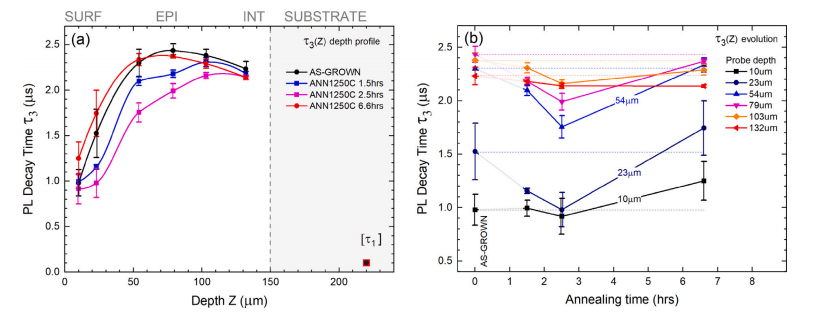
Fig. 4 Analysis of depth resolved carrier lifetime τ3 obtained through TRPL using decay time parameters: (a) cross-sectional carrier lifetime distribution under different heat treatments; (b) Evolution of carrier lifetime at different depths with annealing time
Carbon injection, as an effective VC elimination method, introduces a series of carbon gap related defects in 4H-SiC. These defects include unstable single carbon gap energy levels (such as E0.38) and more stable carbon cluster energy levels (such as ON series and T series). Although carbon injection may lead to a decrease in lifetime due to the formation of new defects in the initial stage, significant improvement in minority carrier lifetime can be achieved in the near surface region by optimizing the injection time (such as 6.6 hours).

Whether you need 4H-SiC wafer for research or for industrial applications, please contact us email at [email protected] and [email protected].
References:
- Karsthof, R., Etzelmüller Bathen, M., Kuznetsov, A., & Vines, L. (2022). Formation of carbon interstitial-related defect levels by thermal injection of carbon into n-type 4H-SiC. Journal of Applied Physics, 131(3).
- Bathen, M. E., Karsthof, R., Galeckas, A., Kumar, P., Kuznetsov, A. Y., Grossner, U., & Vines, L. (2024). Impact of carbon injection in 4H-SiC on defect formation and minority carrier lifetime. Materials Science in Semiconductor Processing, 176, 108316.