
Analysis of Lifetime Control Technology for Si based Power Devices
PAM-XIAMEN can provide various types of silicon wafers: https://www.powerwaywafer.com/silicon-wafer
In early processes, a small number of recombination centers were introduced for power device manufacturing, resulting in devices with relatively slow switching speeds due to the long time required to remove minority carriers during the recombination process. So in order to improve device performance, controllable techniques must be applied, introducing more recombination centers into the lattice to enhance the switching speed of the device. Currently, there are roughly two processes:
1) According to the diffusion of impurities exhibiting deep energy levels in the bandgap;
2) By bombarding the substrate crystal with high-energy ions, lattice defects such as vacancies or interstitial impurities are generated in the crystal.
1. Diffusion Method: Au/Pt Doping Process
Prior to some processes such as electron irradiation, H injection, He injection, etc., work based on diffusion technology has been done to generate deep level defects in the bandgap. Currently, both Au and Pt diffusion are widely used in commercial devices.
The diffusion of Au and Pt in Si is much faster than that of impurity atoms such as B and P, so deep level impurities are introduced after the device structure is manufactured and before metallization. In order to ensure the uniform distribution of deep level impurities in the wafer, it is customary to diffuse them at a temperature of 800-900℃. The solid solubility of impurities depends on temperature, so choosing an appropriate diffusion temperature can adjust the concentration of deep level impurities in Si. The higher the diffusion temperature, the higher the concentration of deep level impurities produced, and the shorter the lifetime. When the diffusion time is up, the wafer temperature must be quickly lowered.
In addition, because the diffusion temperature of deep level impurities is higher than the eutectic point of the metalized metal, deep level impurities can only be introduced before the metallization process. This leads to the inability to test the device before the lifetime control process, and to more accurately control the changes in device electrical properties before and after the introduction of deep level impurities. Moreover, small changes in diffusion temperature and time during the introduction of deep energy levels can lead to significant changes in device performance, resulting in uncontrollable performance after device fabrication. High energy particle irradiation technology can overcome this problem.
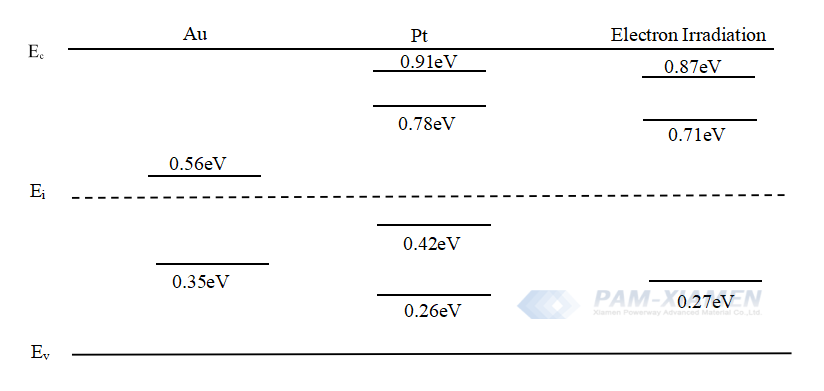
Fig. 1 Deep energy levels generated by recombination centers in silicon
2. Radiation Method: Principles and Advantages
Bombarding Si with high-energy particles causes lattice damage to vacancies and interstitial atoms. At room temperature, both vacancies and interstitial atoms can move, resulting in defects composed of interstitial atoms and vacancies after irradiation.
In order to control the minority carrier lifetime of bipolar power devices, electron irradiation and Co60-γ irradiation have been developed. Their advantages lie in:
1) After metallization, the device can be irradiated at room temperature, allowing for initial and post irradiation testing, making it easier to control the electrical changes caused by irradiation;
2) The lifespan level can be finely controlled by accurately monitoring the irradiation dose and energy;
3) Even distributed irradiation and modulation of process parameters can be achieved through the test results after each irradiation;
4) Low temperature annealing can easily repair radiation damage and eliminate negative gains in device performance caused by excessive irradiation;
5) High energy particle irradiation is more environmentally friendly and clean in the process, avoiding contamination of equipment by Au;
The concentration of recombination centers generated by electron irradiation is proportional to the high-energy electron flux per unit area of the bombarded wafer. The minority carrier lifetime depends on the recombination centers generated by irradiation and the recombination centers that existed before irradiation. Therefore, the minority carrier lifetime is:

In the formula, τi is the initial lifetime before irradiation, ϕ is the electron flux, and the constant K depends on the electron energy used to generate lattice damage.
3. Comparison of Diffusion and Irradiation Techniques
Despite the numerous benefits of current electronic irradiation technology, the control of Au diffusion lifetime still has irreplaceable advantages, as the use of Au diffusion can achieve excellent conductivity characteristics for conducting current. Moreover, defects generated by electron irradiation will dissociate with increasing temperature, posing a potential threat to the long-term stability of power devices.
The recombination center introduced by Au or Pt and electron irradiation will generate multiple deep energy levels in the bandgap, as shown in the fig. 1. The deep energy level closest to the bandgap center has the strongest impact on the process of minority carrier recombination. In order to calculate the lifetime, previous researchers have summarized the composite cross-section data of deep level pairs of holes and electrons that dominate in Si:
| Impurity | Dominant Energy Level/eV | Hole Capture Cross-Section/cm2 | Electron Capture Cross-Section/cm2 |
| Au | 0.56 | 6.08e-15 | 7.21e-17 |
| Pt | 0.42 | 2.7e-12 | 3.2e-14 |
| Electron Irradiation | 0.71 | 8.66e-16 | 1.61e-16 |
From a practical perspective, it is necessary to maintain the smallest possible leakage current while controlling the lifespan, so electron irradiation has become the mainstream technology at present.

Whether you need silicon wafer for research or for industrial applications, please contact us email at [email protected] and [email protected].