
Formation of V-shaped Pits in AlN Templates and Their Role in Strain Regulation +
PAM-XIAMEN offers silicon-based and sapphire-based AlN templates. For product details, please contact: [email protected]
Aluminum Nitride (AlN), as an ideal substrate material for AlGaN-based deep ultraviolet optoelectronic devices, has its crystal quality directly determining device performance. However, due to the lack of native substrates, AlN is typically heteroepitaxially grown on sapphire substrates via techniques like Metalorganic Chemical Vapor Deposition (MOCVD) or Hydride Vapor Phase Epitaxy (HVPE), leading to high-density threading dislocations and significant strain accumulation. Studies indicate that threading dislocations are one of the primary defects affecting AlN crystal quality, with densities potentially reaching 10⁹–10¹⁰ cm⁻².
To reduce dislocation density, various methods have been developed by researchers, such as high-temperature annealing, lateral epitaxial overgrowth, and patterned substrates, but these processes are complex and costly. In recent years, a method involving the preparation of V-shaped pits via phosphoric acid (H₃PO₄) wet etching combined with secondary epitaxial growth has gained attention due to its process simplicity and significant effectiveness. This method selectively etches dislocation regions, forming nano-voids or V-shaped pits, which effectively block the propagation path of dislocations, significantly enhancing the crystal quality of AlN.
1. Formation and Structural Characteristics of V-shaped Pits
The formation of V-shaped pits originates from the selective etching behavior at crystal defects. In heteroepitaxial AlN films, the atomic arrangement mismatch around threading dislocation (TD) lines results in higher chemical potential, making them preferential channels for corrosion in acidic etchants. Research shows that wet etching AlN templates with phosphoric acid (H₃PO₄) solution effectively initiates at dislocation emergence points and forms typical hexagonal V-shaped pits.
1.1 Control of Pit Morphology by Etching Parameters
Etching temperature and time are key parameters controlling the size, density, and depth of V-shaped pits. At lower temperatures (e.g., 373K), the etching reactivity is weak, and the surface remains smooth. When the temperature increases to 423K, uniformly distributed hexagonal V-shaped pits begin to appear on the surface. Further increasing the temperature to 473K or extending the etching time to 7 minutes causes adjacent V-shaped pits to coalesce, forming large voids that may even penetrate to the AlN/sapphire interface.
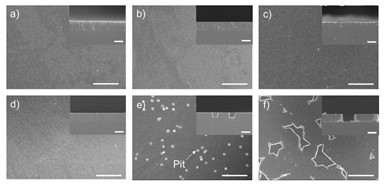
Fig. 1 SEM images of AlN surfaces before/after H₃PO₄ etching at different temperatures: (a) as-grown; (b) 298 K; (c) 323 K; (d) 373 K; (e) 423 K; (f) 473 K.
1.2 Geometric Types of V-shaped Pits and Correlation with Dislocations
Based on etching depth and dislocation type, V-shaped pits can be categorized into two typical structures:
- α-type: Inverted trapezoidal hexagonal structure, where the etching depth can penetrate the entire AlN layer, completely removing the dislocation.
- β-type: Inverted pyramidal structure, with a shallower etching depth, where the dislocation is not completely removed.
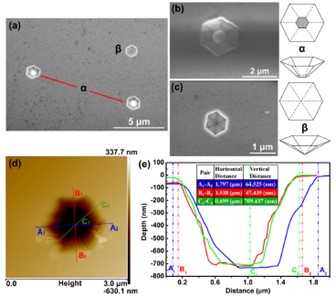
Fig. 2 SEM and AFM images of α-type and β-type V-shaped pits: α-type V-pits have lateral dimensions of approximately 1.5–1.7μm and a depth of about 709 nm, consistent with the primary epitaxial AlN thickness.
2. Regulation of AlN Strain State by V-shaped Pits
The preparation of V-shaped pits is not only a defect engineering method but also an effective strain engineering strategy. By selectively etching to introduce V-shaped pits, the residual stress distribution and state within the heteroepitaxial AlN film can be significantly altered, enabling a controlled transition from tensile strain to compressive strain.
2.1 Stress Relaxation: Evidence from Raman Spectroscopy
Raman spectroscopy provides direct evidence for stress relaxation. Studies by Lee, Zhou, and others confirm that the E₂(high) phonon mode of stress-free AlN lies within the range of 657.4–657.8cm⁻¹. Untreated AlN films exhibit residual tensile stress due to lattice mismatch, causing a blue shift in the characteristic peak position.
After forming V-shaped pits, the E₂(high) peak position systematically redshifts. Data from Lee et al. show that after 7 minutes of etching, the peak shifts to 659.32cm⁻¹, and the calculated stress decreases from -0.463GPa to -0.608GPa, confirming effective stress relaxation.
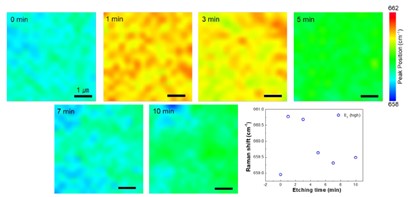
Fig. 3 Redshift of the E₂(high) peak position with increasing etching time, indicating relaxation of residual stress
2.2 Mechanism of Strain State Transition
V-shaped pits regulate strain through a dual mechanism:
- Direct Elimination of Stress Sources: The etching process directly removes dislocations acting as stress centers, releasing local lattice distortion energy. Reciprocal Space Map (RSM) analysis shows that the diffraction peak of AlN shifts towards a relaxed state after etching, and a strain gradient appears, confirming stress redistribution.
- Induction of Compressive Strain: During secondary epitaxial growth on the V-pit patterned template, the sidewalls promote lateral overgrowth, effectively blocking strain transmission from the substrate and causing the newly grown epilayer to exhibit a compressive strain state. Both RSM and Raman data confirm the presence of compressive strain (E₂(high) peak at 658.65 cm⁻¹).
This transition in strain state holds significant application value. As demonstrated in studies by Zhou et al., the initial highly tensile-stressed AlN exhibited surface cracking, whereas the sample treated with V-pits and secondary epitaxy showed a crack-free surface, demonstrating the positive role of compressive strain in suppressing crack formation.
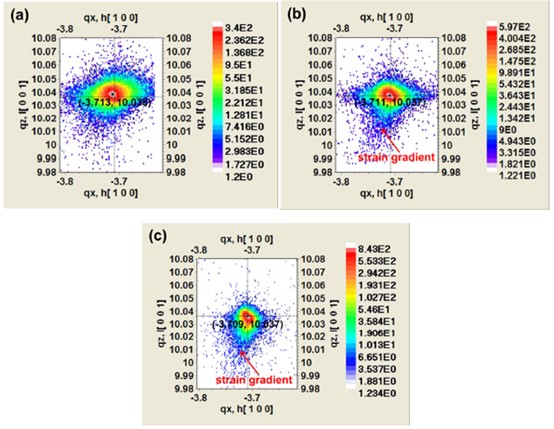
Fig. 4 RSM images: (a) Initial state of the AlN template, (b) AlN template after etching, (c) After secondary epitaxy: illustrating the complete transition process from tensile strain to compressive strain.
To sum up, introducing V-shaped pits into AlN templates via H₃PO₄ wet etching, combined with secondary epitaxial growth, represents an efficient and low-cost strategy for enhancing crystal quality and regulating strain. This method not only effectively suppresses the propagation of threading dislocations but also enables the transition of strain from tensile to compressive, thereby significantly improving the performance of AlN-based optoelectronic devices.

Whether you need AlN templates for research or for industrial applications, please contact us email at [email protected] and [email protected].
References:
- Lee, M., Son, H., Lee, H. Y., Moon, J., Kim, H., Park, J. I., … & Kim, U. J. (2020). Nanovoid-driven highly crystalline aluminum nitride and its application in solar-blind UV photodetectors. Journal of Materials Chemistry C, 8(41), 14431-14438.
- Zhou, X., Chen, Y., Zhang, Z., Miao, G., Jiang, H., Li, Z., & Song, H. (2021). The effect of dislocation-related V-shaped pits preparation on the strain of AlN templates. Thin Solid Films, 730, 138706.